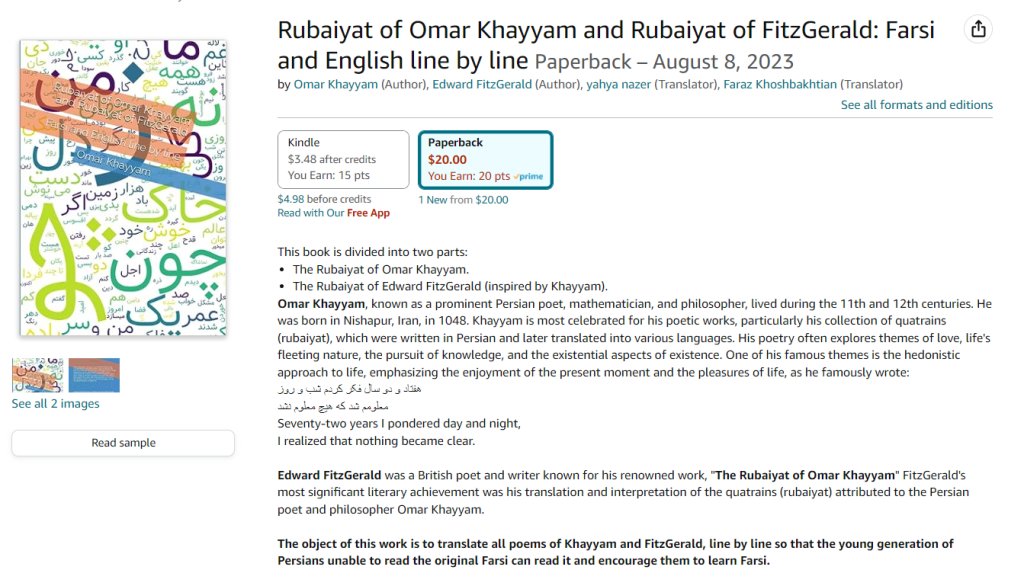
158 philosophical quatrains in the original Persian — plus FitzGerald's celebrated Victorian paraphrase. The world's most translated Persian poet, restored to his own voice.
Omar Khayyam was simultaneously one of the greatest mathematicians of the medieval world and one of its most haunting poets. Born in Nishapur in 1048, he reformed the Persian calendar, solved cubic equations that baffled his contemporaries, and — in his spare hours — composed four-line quatrains of devastating philosophical beauty.
His rubaiyat were largely unknown outside Iran until Edward FitzGerald published a loose English paraphrase in 1859. FitzGerald's version became one of the most popular poetry books in the Victorian era — but it is a paraphrase, not a translation. Our edition restores Khayyam's own voice: a literal, line-by-line bilingual rendering alongside FitzGerald's famous text for direct comparison.
Three famous quatrains — the original Farsi with our literal English translation, side by side.
Ghiyāth ad-Dīn Abu'l-Fatḥ ʿUmar ibn Ibrāhīm Khayyam Nishapuri was born in Nishapur on 18 May 1048. His surname "Khayyam" means tent-maker in Arabic — likely his family's trade. He lived during a golden age of Islamic science and literature, under the patronage of the Seljuq sultan Malik-Shah I.
As a mathematician, Khayyam produced the first systematic classification of cubic equations and methods for their geometric solution — work that would not be equalled in Europe for centuries. As an astronomer, he led the reform of the Persian calendar, producing the Jalali calendar whose solar year measurement (365.24219858 days) was more accurate than the Gregorian calendar adopted in Europe 500 years later.
His rubaiyat — short, four-line philosophical quatrains — were composed alongside this scientific work, seemingly as personal meditations on mortality, free will, the pleasures of the present moment, and the futility of religious certainty. They were not intended for publication. Their survival is largely accidental.
What makes Khayyam uniquely remarkable is that his poetic fame is almost incidental to his scientific stature. In his own time, he was known first and foremost as a mathematician and astronomer of the first order — a court scientist whose work reshaped Persian civilization.
The rubaiyat were, for Khayyam, private meditations — philosophical asides composed between mathematical treatises. They were not gathered or published during his lifetime. It is this private quality — the sense of a brilliant, unsentimental mind thinking aloud about mortality and wine — that gives them their enduring power.
Khayyam led the astronomical commission that reformed the Persian solar calendar. His measurement of the solar year (365.24219858 days) was more accurate than the Gregorian calendar by a factor of 7 seconds per year.
His Treatise on Demonstration of Problems of Algebra (1070) was the first systematic classification of cubic equations and general geometric methods for solving them — not equalled in Europe until the 16th century.
Khayyam discovered the binomial theorem and the triangular array of binomial coefficients now known as Pascal's Triangle — six centuries before Pascal was born.
Alongside his scientific and poetic work, Khayyam wrote philosophical treatises on the nature of existence, free will, and metaphysics — revealing a mind engaged equally with science, poetry, and philosophy.
Our unique two-part edition lets readers compare both: Khayyam's own words in a faithful literal translation, and FitzGerald's celebrated 1859 Victorian paraphrase. The same rubai — three completely different experiences of the same poem.
انگشتِ قضا مینویسد و میگذرد
نه تقوا نه خرد آن را باز میگرداند
نه اشکِ تو یک واژه از آن میشوید
نه دعا نه ندامت خطی از آن میزداید
The finger of fate writes and moves on —
Neither piety nor wisdom turns it back.
Nor do your tears wash a single word away —
Nor does prayer or regret erase a line of it.
The Moving Finger writes, and, having writ,
Moves on: nor all thy Piety nor Wit
Shall lure it back to cancel half a Line,
Nor all thy Tears wash out a Word of it.
The rubai (رباعی — plural: rubaiyat) is one of the oldest and most compact forms in Persian poetry — four hemistiches (half-lines) with a distinctive AABA rhyme scheme. Khayyam made it the vehicle for an entire philosophical worldview.
Each rubai is complete and self-contained — a single philosophical observation, image, or argument compressed into four lines. Khayyam's genius was packing the weight of an entire treatise into this tiny form: impermanence, the pleasures of wine, the futility of religion, the mystery of fate — all in four lines.
The third line — the "B" rhyme — is the most distinctive feature of the form. It creates a momentary pause, a breath, before the final line completes the thought. Khayyam uses this structure to great effect: building a premise in lines 1–2, introducing a complication in line 3, and landing the devastating conclusion in line 4.
Our unique Khayyam edition presents both translations in a single volume — Khayyam's original Persian with our faithful literal English, followed by FitzGerald's celebrated Victorian paraphrase. Available in Kindle and Paperback on Amazon.
A unique two-part bilingual edition — Part 1 presents all 158 rubaiyat of Khayyam in the original Persian with a faithful line-by-line English translation. Part 2 presents FitzGerald's 1859 paraphrase in its entirety. Readers can compare both interpretations side by side and experience the richness and differences between a literal rendering and a Victorian poetic paraphrase.
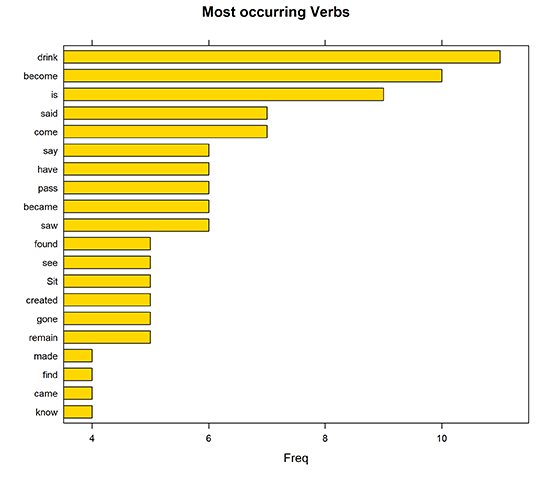
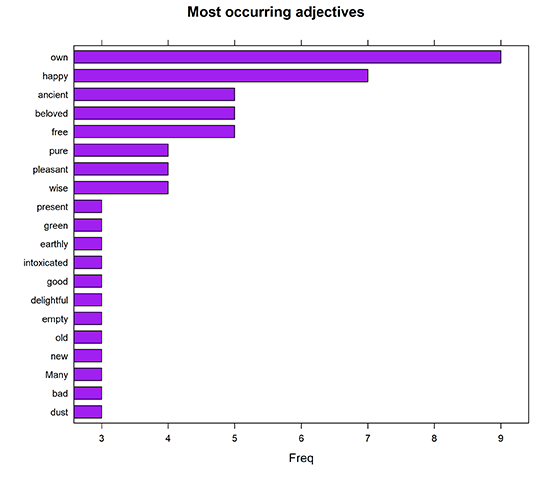
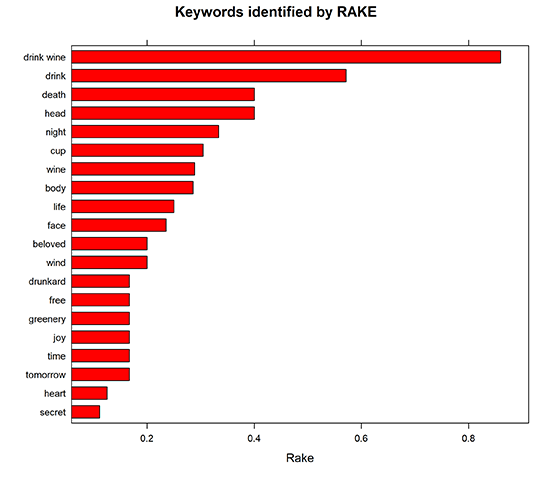
Four NLP visualisations of the English translation of Khayyam's 158 rubaiyat. The compact corpus makes every repeated word highly significant — wine (52 occurrences) is the standout content word, confirming Khayyam's philosophy in a single term. See the full analysis on the Analysis page.
A selection of the most celebrated rubaiyat — our literal English translation alongside the original Farsi opening line.
| # | Literal English Translation | Theme | مطلعِ رباعی |
|---|---|---|---|
| 1 | "Seventy-two years I pondered day and night — I realised that nothing became clear." | Philosophical resignation | هفتاد و دو سال فکر کردم شب و روز |
| 2 | "The Moving Finger writes and having writ moves on — nor piety nor wit shall lure it back." | Fate & inevitability | انگشتِ قضا مینویسد و میگذرد |
| 3 | "A loaf of bread, a flask of wine, a book of verse — and thou beside me in the wilderness." | Carpe diem | یک قُرصِ نان و یک سبو می درویشانه |
| 4 | "Come, fill the cup — in the fire of Spring the winter-garment of repentance fling." | Seizing the moment | بیا که قلعهٔ عمر است این بهارِ خوش |
| 5 | "Awake! For Morning in the Bowl of Night has flung the Stone that puts the Stars to Flight." | Dawn & awakening | بیدار شو که صبح دمید از افق |
| 6 | "The Worldly Hope men set their Hearts upon turns Ashes — or it prospers, and anon like Snow upon the Desert's dusty face melts." | Impermanence of hope | امیدِ جهانی که آرزوی دلهاست |
| 7 | "We are no other than a moving row of Magic Shadow-shapes that come and go." | Human transience | ما سایههای متحرکِ جهانیم |
| 8 | "I sometimes think that never blows so red the Rose as where some buried Caesar bled." | Death & renewal | گل از خاکِ شاهان رسته است |
| 9 | "Into this Universe, and why not knowing — nor whence, like Water willy-nilly flowing." | Existential mystery | در این جهان آمدم نه به اختیار |
| 10 | "O, Thou who Man of baser Earth didst make, and who with Eden didst devise the Snake — for all the Sin wherewith the Face of Man is blackened, Man's Forgiveness give — and take!" | God & free will | ای آنکه آدم را ز خاک ساختی |
| 11 | "Myself when young did eagerly frequent Doctor and Saint, and heard great argument about it and about — but evermore came out by the same door as in I went." | Futility of learning | در جوانی پیِ دانشمند و پیر بودم |
| 12 | "The grape that can with Logic absolute the Two-and-Seventy jarring Sects confute." | Wine vs. theology | می آن است که هفتاد و دو ملت را |
| 13 | "Here with a Loaf of Bread beneath the Bough, a Flask of Wine, a Book of Verse — and Thou." | Simple joy | زیرِ بید و نان و می و دلدار |
| 14 | "Strange, is it not? That of the myriads who before us passed the door of Darkness through, not one returns to tell us of the Road." | Death & the unknown | شگفت نیست که از آن هزاران |
| 15 | "The Vine had struck a Fibre: which about if clings my Being — let the Dervish flout." | Love of wine | تاکی در من ریشه زد |
Wear the most celebrated philosophical couplet of Khayyam's Rubaiyat — Farsi on the front, English on the back. Heavyweight unisex crewneck, all sizes on Etsy.